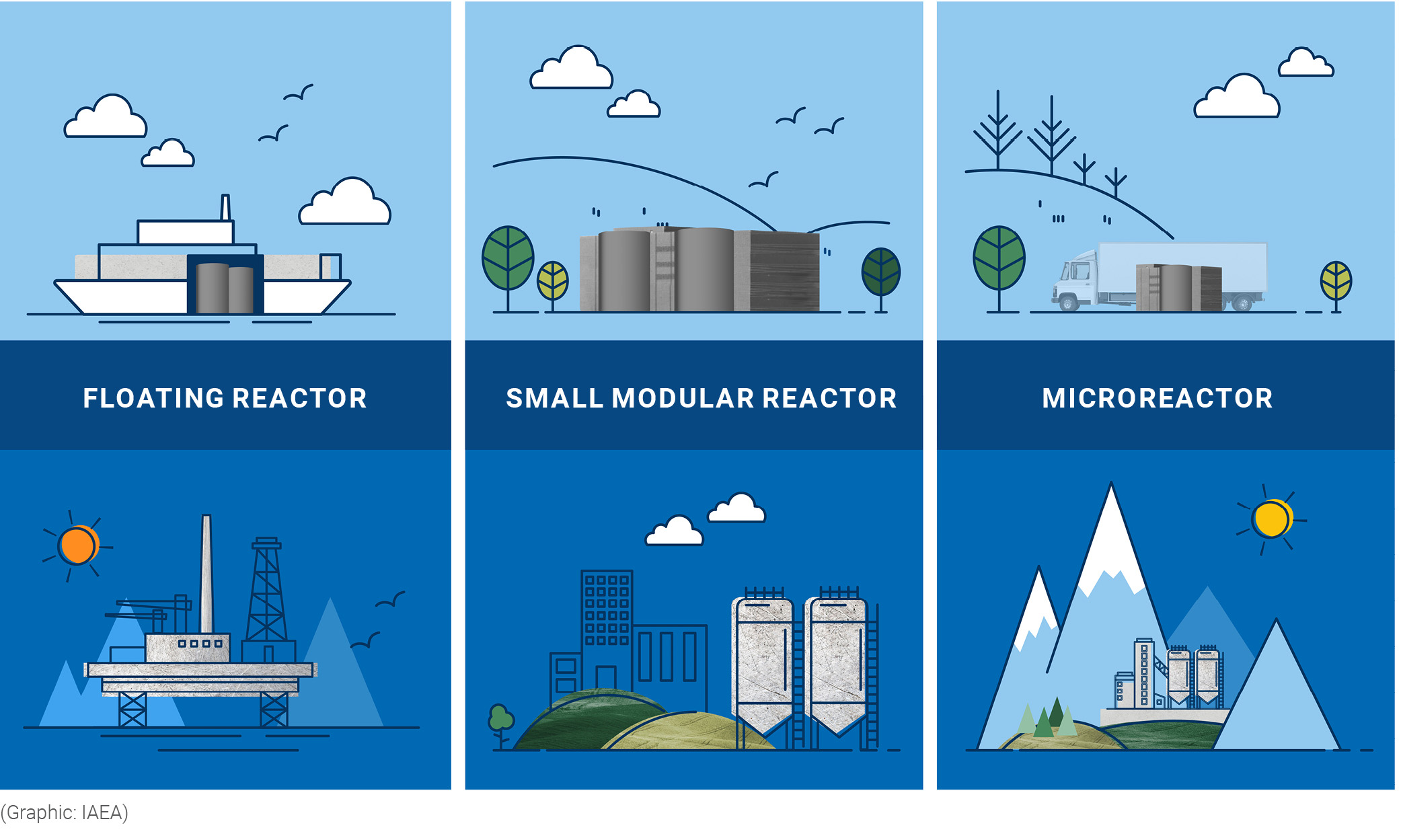
The nuclear landscape is undergoing a transformation. While today’s emergency planning focuses on several hundred large, stationary nuclear power plants, the future may involve managing thousands of smaller reactors distributed across the globe — including in remote areas and industrial sites. Some reactors may be mobile, transported by ship or truck to meet energy demand in different locations. This dramatic shift has profound implications for how the world prepares for and responds to nuclear emergencies.
Small modular reactors (SMRs), floating nuclear power plants and microreactors need emergency preparedness and response (EPR) strategies tailored to their unique characteristics. The IAEA is working with countries to ensure that safety measures keep pace with innovation.
‘Digital twins’
Advances in nuclear technology coincide with another major trend: the rise of artificial intelligence (AI), which could galvanize the way operators and authorities prepare for nuclear and radiological emergencies.
“Currently it takes months to develop emergency scenarios and train for them,” said Ryan Rockabrand, an EPR expert who has advised the National Nuclear Security Administration and several other US agencies. "It is a complex process that requires extensive coordination. Artificial intelligence could accelerate and optimize these efforts.”
How would this work? Machine learning programmes already gather extensive information on nuclear power plants to facilitate maintenance. In the future, operators could use advanced language models, drones and robots to monitor plants in real time.
Based on this data, AI systems could create ‘digital twins’ — detailed simulations of real nuclear power plants — to run scenarios, calculate risks and update emergency plans on an ongoing basis.
“We will still need robust planning and regular training,” Rockabrand added. “But AI will help us respond faster and more effectively when something happens. It will enable us to adapt more quickly to emerging risks.”
Challenges and opportunities of new nuclear technology
Small, advanced reactors have unique emergency planning considerations. Their small size and enhanced safety features might reduce the likelihood of emergencies. Some consider these factors to be so significant that they argue for smaller emergency planning zones. In reality, the situation is more complex.
“SMRs are often praised for their standardized design, but that does not mean that we will implement a one-size-fits-all approach to emergency planning and response,” said Monica Dobbertin, an IAEA emergency preparedness coordinator. “Some sites may host a single reactor while others could operate multiple interconnected reactors that together reach the dimensions of traditional large plants. We must tailor emergency preparedness and response plans to the specific layout, location and operational context of each site.”
Mobile reactors add another layer of complexity. Nuclear power plants that move within or across national borders will require close coordination among authorities in all affected regions to ensure safe and secure transit.
AI for emergency response
New technologies could also improve first responders’ equipment, increasing their safety when they need to step in. Responders may, for example, use augmented reality goggles that display real time data such as radiation levels in their field of vision. This could help them avoid harmful areas while navigating through emergency sites.
AI could also revolutionize public communication during emergencies — an essential component of EPR. Predictive modelling could enable authorities to anticipate false or misleading information before it even appears. Under expert guidance, AI could monitor social media for misinformation and swiftly propose strategies to counter it. Emergency messages could be tailored to different audiences based on language, education level, age and other factors, making communication more effective. AI-powered chatbots could help overwhelmed call centres prioritize responses, ensuring that those most affected by an emergency receive help first.
Despite AI's promise, experts urge careful implementation. “When it comes to using artificial intelligence in EPR, we need to be cautious,” Rockabrand said. “The technology offers vast potential, but it is still prone to mistakes. We need very careful design processes, well-trained models and experienced humans to supervise the AI and make the final decision.”
Precautions in addressing cybersecurity risks are paramount. Experts recommend running dedicated AI models on-site without Internet connections to prevent hacker attacks on critical safety systems.
The IAEA's role
The IAEA has adopted a proactive approach to new technologies and is integrating them into the Safety Standard on “Preparedness and Response for a Nuclear or Radiological Emergency” (GSR-7). The Agency also supports countries as they incorporate innovations into their emergency planning. Recent IAEA technical meetings and workshops have highlighted AI's growing importance in nuclear emergency communication.
The IAEA continues to recommend an ‘all hazards approach’ for emergency preparedness, ensuring that all possible threats are considered — whether they involve large reactors, SMRs, floating nuclear plants or microreactors.
“Emergency preparedness and response will change as new technologies become available,” Dobbertin said. “The underlying safety requirements will not.”
As the nuclear industry prepares for its most significant transformation in decades, the combination of AI, advanced reactor designs and innovative emergency planning approaches have the potential to make nuclear power both more widespread and safer than ever before. The challenge now lies in ensuring that emergency preparedness keeps pace with rapid technological change. International cooperation, in line with IAEA guidance, will be essential.