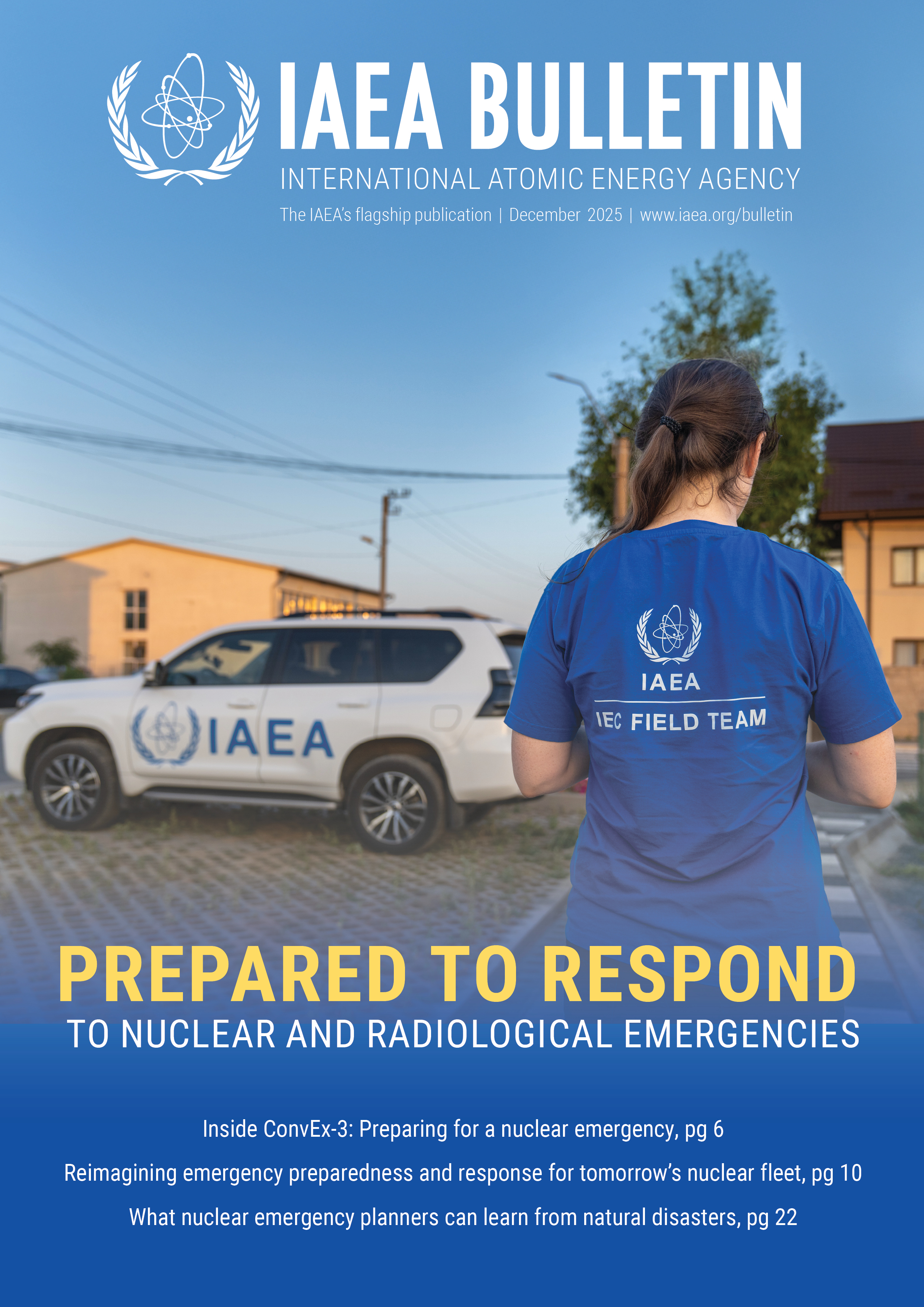
At 8 o’clock in the morning on 24 June 2025, as part of a worldwide emergency preparedness and response exercise, an email alert lit up monitors inside the Incident and Emergency Centre (IEC) at the IAEA’s Headquarters in Vienna: “General Emergency at a Nuclear Facility — Cernavod? nuclear power plant”. Within minutes, requests for information were pouring in. Secure phones rang: radiation protection experts, public information officers and nuclear installation specialists were summoned to emergency response centres around the world.
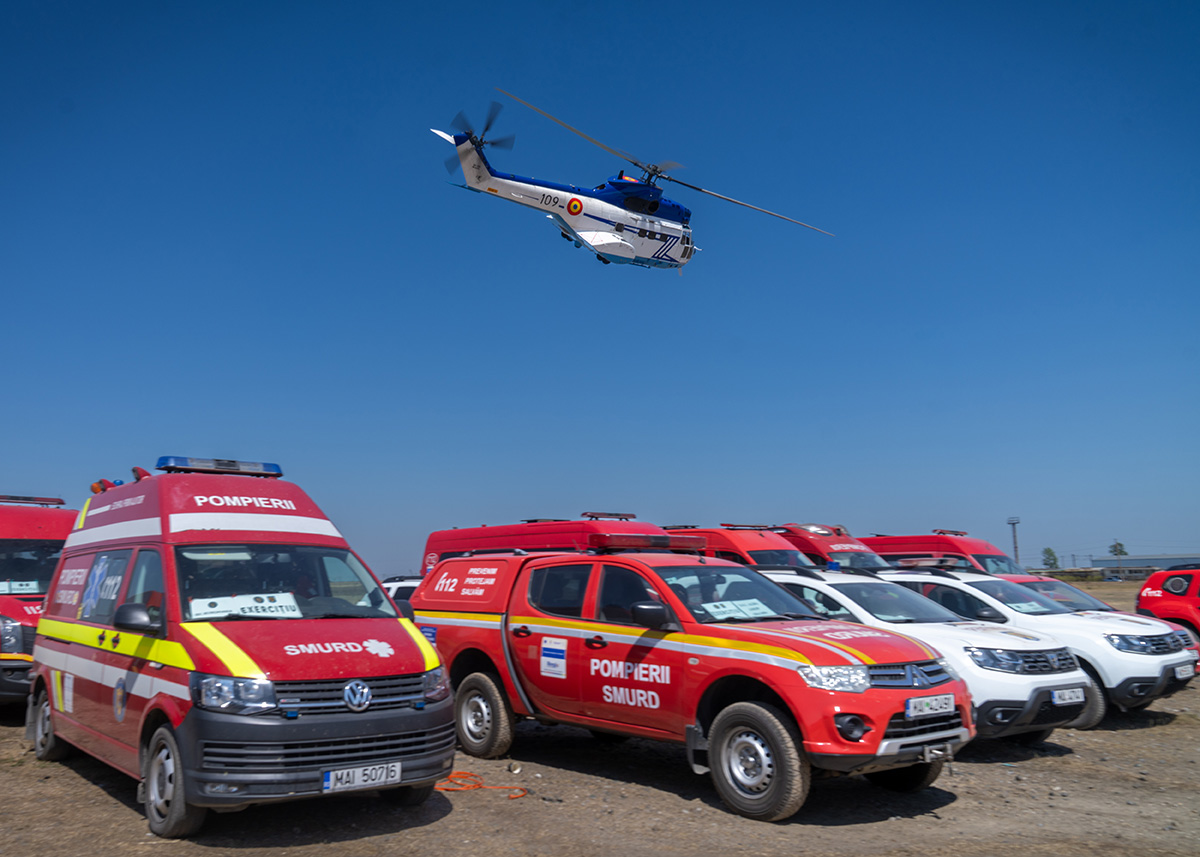
Meanwhile, 1200 kilometres away in Romania, firefighters and mobile monitoring teams sprang into action around the Cernavod? nuclear power plant. The scenario: an accident involving a loss of coolant in the reactor core compounded by a cyberattack and an earthquake, forcing the authorities to declare a general emergency and order people in the vicinity to shelter in place or evacuate.
The ConvEx-3 international nuclear emergency exercise had begun.
What is ConvEx-3?
ConvEx — short for Convention Exercise — is the IAEA’s mechanism for testing the readiness of the international operational framework for emergency preparedness and response set down in the 1986 Early Notification and Assistance Conventions. Level 3 exercises, which are conducted every three to five years, simulate the most severe nuclear or radiological emergencies and fully mobilize the IAEA’s Incident and Emergency System (IES).
“Preparedness is not a matter of probability, it is a matter of responsibility,” said IAEA Director General Rafael Mariano Grossi at the launch of the 2025 exercise.
ConvEx-3 allows countries to evaluate their ability to respond to emergencies in a realistic yet safe setting, revealing both strengths and areas for improvement.
“Exercises are essential to rigorously test the response capabilities of all participants, improving their ability to communicate and collaborate swiftly and effectively in the face of a nuclear or radiological emergency,” said Karine Herviou, IAEA Deputy Director General and Head of the Department of Nuclear Safety and Security.
Over a year of preparation
Large-scale international exercises such as ConvEx-3 require enormous effort. Romania’s application to host the 2025 session was accepted in late 2023. After 4 technical meetings and multiple workshops and dry runs of field equipment, more than 30 qualified IES responders and hundreds of national experts were ready to participate in the 36-hour exercise.
“We pushed ConvEx-3 beyond expectations — combining nuclear emergency with earthquake response. This tested Romania’s multi-agency coordination under pressure. From strategic command to field deployment, we trained for complexity,” said Raed Arafat, State Secretary and Head of the Department of Emergency Situations in Romania’s Ministry of Internal Affairs. “Preparedness isn’t optional — it’s a national responsibility and a global obligation.”
Recognizing that any future nuclear emergencies would likely have cross-boundary and regional impacts, Bulgaria and the Republic of Moldova — Romania’s neighbours — were closely involved in the exercise. They ran parallel command posts and shared dispersion data with the IEC.
“As a neighbouring country and a participant in the IAEA’s Response and Assistance Network, Bulgaria was able to test and assess its national procedures for requesting, providing and receiving international assistance under near-real conditions,” said Lyudmila Simeonova, Head of Emergency Planning and Preparedness at the Bulgarian Nuclear Regulatory Agency. “These activities will serve as a basis for analysing and enhancing our national response capabilities in the event of a nuclear or radiological emergency.”
Record-breaking participation
Registration for this year’s ConvEx-3 was the largest on record: 76 States and 10 organizations took part at differing levels of complexity — from activating their own emergency centres, to exchanging information via the Unified System for Information Exchange in Incidents and Emergencies (USIE), to dispatching assistance teams through the IAEA Response and Assistance Network. During the exercise, 247 requests for information and status updates were uploaded to USIE.
Romania hosted the very first ConvEx-3 in 2005 — also at the Cernavod? nuclear power plant — pioneering a model for international coordination. Subsequent exercises were hosted by Mexico (2008), Morocco (2013), Hungary (2017) and the United Arab Emirates (2021). Each ConvEx-3 simulated a different kind of nuclear emergency — from reactor accidents to radiological ‘dirty bombs’ — to test emergency preparedness and response plans against a variety of threats.
“From ConvEx-3 host in 2005 to regional leader in 2025, Romania drives innovation in nuclear and radiological emergency response,” said Petre Min, Head of the Emergency Operations Centre at Romania’s National Commission for Nuclear Activities Control. “In today’s world, preparedness must be regional, rapid and relentlessly adaptive. Crises don’t respect borders, so we trained together with our neighbours for reality, not theory.”
Lessons learned and next steps
ConvEx-3’s findings will be distilled into updated guidelines, communication protocols and training for emergency responders worldwide.
Historically, each ConvEx-3 has provided critical lessons that have shaped global emergency preparedness. For instance, the 2013 ConvEx-3 in Morocco, which focused on a terrorism-driven radiological emergency, spurred improvements in how security incidents are handled alongside safety measures. The scenario for the 2017 exercise in Hungary was a ‘Fukushima-like’ reactor accident, which helped participants identify gaps in harmonizing protective actions across Europe.
For the 2025 edition, the IEC will compile an exercise evaluation report capturing system-wide observations that will be discussed at a technical meeting during the International Conference on Nuclear and Radiological Emergencies to be held in Riyadh, Saudi Arabia, in December 2025.
Exercises such as ConvEx-3 are designed to identify gaps in national emergency preparedness and response plans, procedures and coordination mechanisms. The IAEA supports countries in addressing these gaps through national and regional technical cooperation projects. Romania is implementing a national technical cooperation project to strengthen its regulatory infrastructure for nuclear and radiation safety, including by enhancing emergency preparedness and response through capacity building, improved early notification systems and alignment with IAEA Safety Standards. Regional technical cooperation projects enable countries to share information and expertise in areas such as public communication and crisis coordination.
Thoughts are already turning towards the next ConvEx-3. The simulation will build on conclusions from the 2025 edition while taking into account advances in technology and lessons from any real-world incidents that might occur. The continuity of these exercises ensures that emergency preparedness is a living process, continually adapting and improving. The cycle of ‘train, test, learn and improve’ will continue.