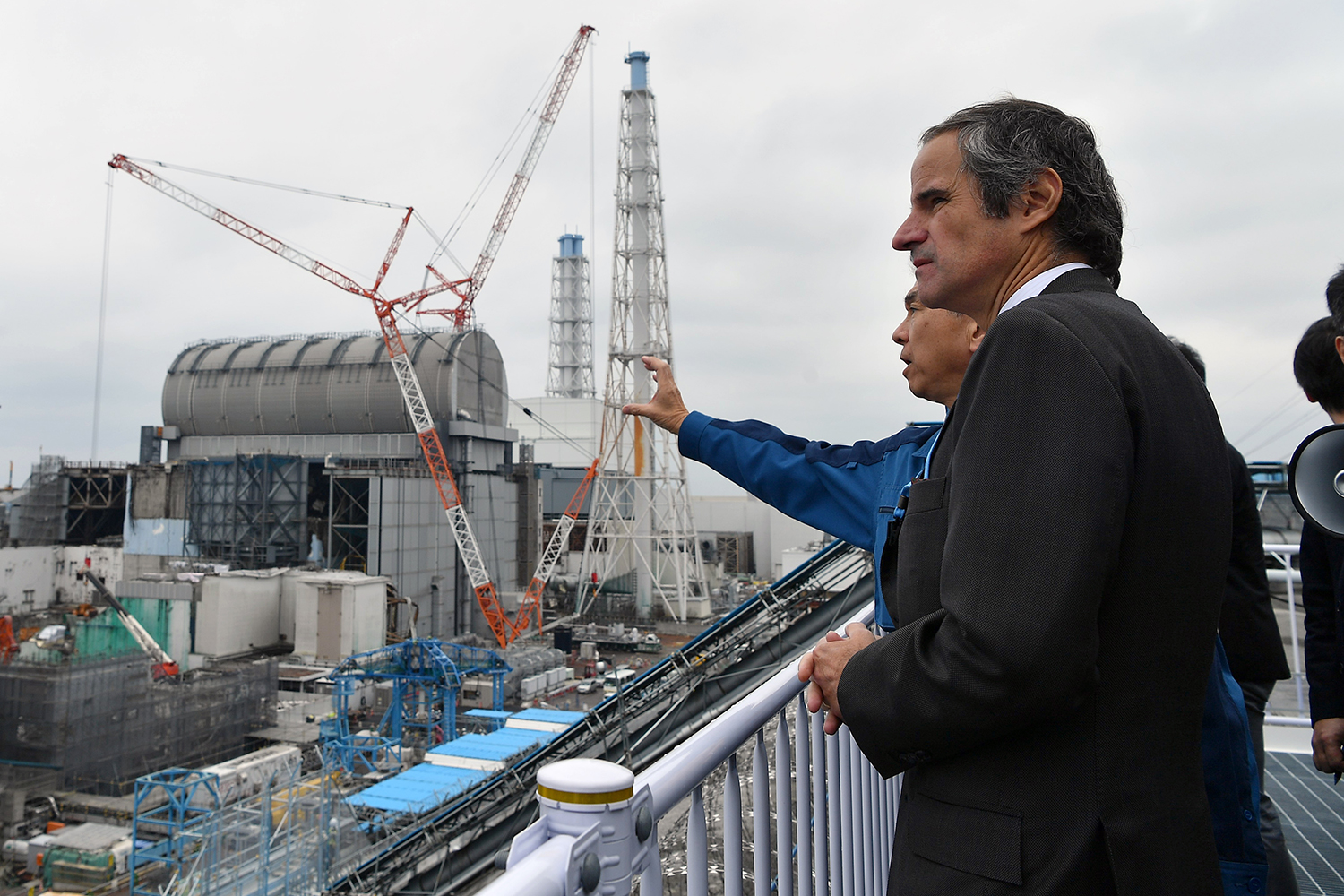
Around the world, the IAEA implements technical measures, known as safeguards, to verify that nuclear material and technology remain in peaceful use. This work is also performed at Japan’s Fukushima Daiichi nuclear power plant. Despite the challenges associated with implementing safeguards at the site of a nuclear accident, IAEA safeguards provide assurance on the peaceful use of nuclear material and technology. The Japan Safeguards Office (JSGO), part of the Nuclear Regulation Authority of Japan, administers national safeguards and facilitates IAEA verification activities.
The Fukushima Daiichi accident
On 11 March 2011, a 9.0 magnitude earthquake struck off the coast of Honshu, Japan’s main island, causing a tsunami with waves more than ten metres high. This dual disaster caused a Level 7 major accident at the Fukushima Daiichi nuclear power plant, according to the International Nuclear and Radiological Event Scale. Of the site’s six reactors, three suffered major damage, including partial core melting; one was severely damaged; and two suffered minor damage.
Prior to the accident, the safeguards regime at the Fukushima Daiichi nuclear power plant had included inspections to verify that the inventory of nuclear material at the facility matched Japan’s declaration to the IAEA; unannounced inspections of the facility’s inventory at random intervals; and verification of the facility design information provided by Japan. These activities were performed to confirm that the State’s declarations of nuclear material were correct and complete.
In the immediate aftermath of the accident, severe radiological conditions and damage to the site’s infrastructure prevented IAEA safeguards inspectors from performing their work. IAEA surveillance cameras were rendered inaccessible, as were seals applied to nuclear material. Unsafe conditions and the loss of continuity of knowledge from previous inspections posed unprecedented challenges to safeguards implementation.
The need for innovation
After the accident, IAEA inspectors set about determining how safeguards implementation could resume. As soon as conditions allowed, the IAEA resumed verification activities in accessible areas. The IAEA tailored verification measures to the type and condition of the fuel, and containment and surveillance measures, such as seals and cameras, were maintained for accessible fuel assemblies.
However, the inaccessible nuclear material in the three most severely damaged reactors called for innovative safeguards measures.
“Implementing safeguards at Fukushima Daiichi is complex,” said Susan Pickett, Head of the IAEA Regional Office in Tokyo. “The IAEA continues to work closely with JSGO to develop novel and specific approaches to ensure optimal safeguards now and in the future.”
Developing technology for re-verification
As the spent fuel and fuel debris from the damaged reactors are recovered, the IAEA re-verifies the retrieved nuclear material and places it under routine verification activities. However, the recovery process is challenging. The Tokyo Electric Power Company (TEPCO) is testing a robotic arm developed in the United Kingdom that can manoeuvre inside the damaged primary containment vessels and retrieve debris. The boom-style arm transfers the debris for initial analysis to a sealed, negative-pressure container where it is safely contained until its radioactivity is below a set standard. TEPCO has already retrieved two small samples of fuel debris using a telescopic arm device at one of the reactors. Though this technology is still in development, the nuclear material it retrieves will be made available for IAEA verification.
While the inaccessible material is still in situ, the IAEA’s outdoor cameras and a radiation monitoring system provide assurances that no undeclared retrieval of nuclear material from the damaged units occurs. As the material is recovered, the IAEA stands ready to monitor this process, and to place the material under safeguards once retrieved.
“Japan has a successful history of cooperation with the IAEA in nuclear verification, and the work we perform together so that safeguards are implemented at Fukushima underlines this,” said Yuko Nakagiri, Director of JSGO. “We will continue to cooperate and work with the IAEA to ensure that appropriate safeguards methods continue to be updated as the decommissioning work at the site progresses.”
To date, the IAEA has re-verified over 87% of the fuel assemblies that were on site during the accident, and it monitors the remaining material, which has been inaccessible since the accident. Despite the unprecedented challenges, the IAEA safeguards have adapted to the unique circumstances of Japan’s Fukushima Daiichi nuclear power plant.