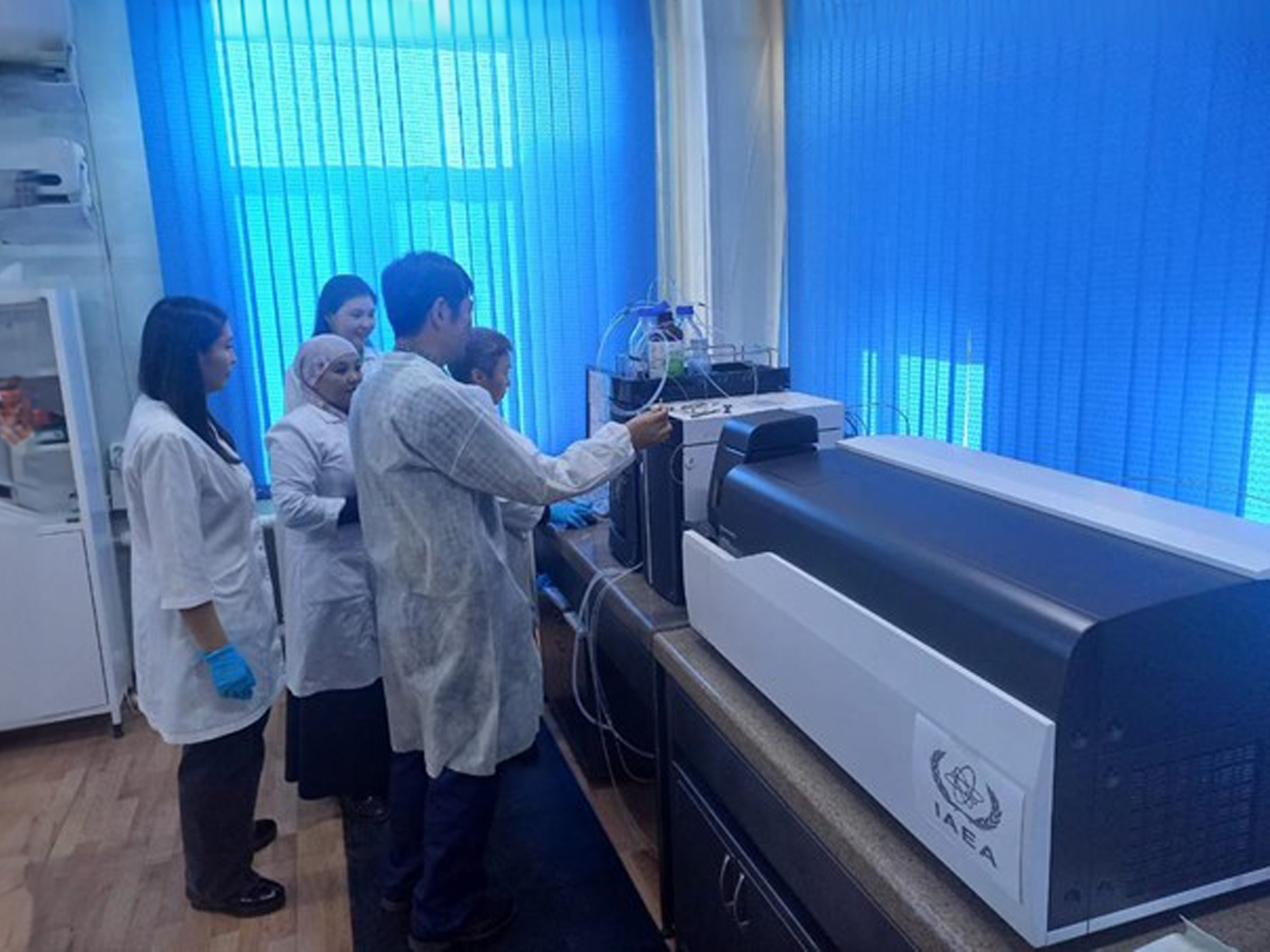
Saint Lucia has opened a laboratory that strengthens its capacity to test for chemical hazards in food. Established with IAEA support through the Joint FAO/IAEA Centre of Nuclear Techniques in Food and Agriculture and the IAEA’s technical cooperation programme, the laboratory enhances the country’s ability to safeguard public health and meet international market standards.
Nuclear Science Boosts Food Safety Testing in Saint Lucia
Success story
Saint Lucia strengthens food safety with a new nuclear science laboratory to test for pesticides, antimicrobials and other chemical hazards.

Laboratories need capacity to test to guarantee safety of products like bananas. (Photo: J.Sasanya/IAEA)
Tackling Food Safety Challenges
Food safety is a national priority for Saint Lucia, with recent efforts focused on enhancing laboratory capacity to test for chemical hazards in food. With over 600 registered pesticides and other chemicals in use in the country, the need for reliable testing continues to increase. Many of these substances, commonly used in commercial pest control, contain active ingredients that may pose risks to human health and the environment.
Local farmers and consumers have also expressed concern about the use of antimicrobials in animal production, especially poultry, and in animal feed. Numerous products claim to be free of veterinary drugs, and it is imperative that such claims are verified through proper laboratory testing. The excessive use of antimicrobials has implications for human and environmental health and contributes to the growing global concern over antimicrobial resistance.
For all these reasons, Saint Lucia recognized an urgent need to strengthen its capacity to routinely test for and monitor the presence of chemical hazards in food.
Building National Capacity
The IAEA, through its technical cooperation programme and the Joint FAO/IAEA Centre, provided state-of-the-art laboratory equipment and testing material, technical training and scientific guidance for staff at Saint Lucia’s National Agricultural Diagnostic Facility.
With this enhanced capacity, the laboratory now conducts essential food safety tests using nuclear, isotopic and complementary techniques. For example, the laboratory tests for a wide range of pesticides in fruits and vegetables such as bananas, carrots, sweet potatoes and onions to ensure that they meet international market standards. Previously, such testing had to be outsourced to regional and international facilities, creating significant delays and additional costs and affecting regulatory decision-making.
Many small island developing States are net food importers and therefore face the challenge of ensuring that food imports are safe for human consumption. However, often their capabilities for testing food safety are weak or non-existent. These countries are also affected by the impacts of climate change, which exacerbate food safety hazards and associated risks to consumers.
“Supporting countries in building or strengthening their own food safety testing laboratories to better protect consumers and facilitate trade is one of our goals,” said Dongxin Feng, Director of the Joint FAO/IAEA Centre. “Small island States like Saint Lucia face unique food safety challenges and vulnerabilities, and we are pleased to provide the relevant technical assistance to address some of them.”
Advanced Techniques in Action
The laboratory now applies techniques such as radioreceptor assays — which use carbon-14 and tritium tracers — to quickly and cost-effectively detect veterinary drug and pesticide residues in poultry, other animal and plant products and animal feed. This approach helps prevent contaminated feed from entering the food chain.
With these analytical services in place, food samples are being collected for testing nationwide with the support of local farmers, agro-processors and government institutions such as the Bureau of Standards and the Trade Export Promotion Agency.
“We are pleased that our laboratory — now the most extensive food testing facility in Saint Lucia, and the only one equipped in the country to test for chemical hazards such as pesticides and antimicrobial residues in food — can perform tests to ensure that our food is safe,” said Hannah Romain, Chief Plant Research Officer at the Ministry of Agriculture, Fisheries, Food Security and Rural Development. “Our goal is to continue enhancing these much-needed laboratory capabilities, provide more services to the country and possibly the region, and meet both safety and market requirements.”