<dd id="rw0xn"></dd>

  • <label id="rw0xn"></label>

  • <sup id="rw0xn"><strike id="rw0xn"></strike></sup><label id="rw0xn"></label>
      <th id="rw0xn"></th>
    1. <var id="rw0xn"></var>
        1. <table id="rw0xn"></table>

          <sub id="rw0xn"><meter id="rw0xn"></meter></sub>

          IAEA Partners with Türkiye’s TENMAK Institute to Advance Nuclear Applications in Food and Agriculture

          Türkiye’s TENMAK Institute designated as IAEA Collaborating Centre for nuclear applications in food and agriculture.

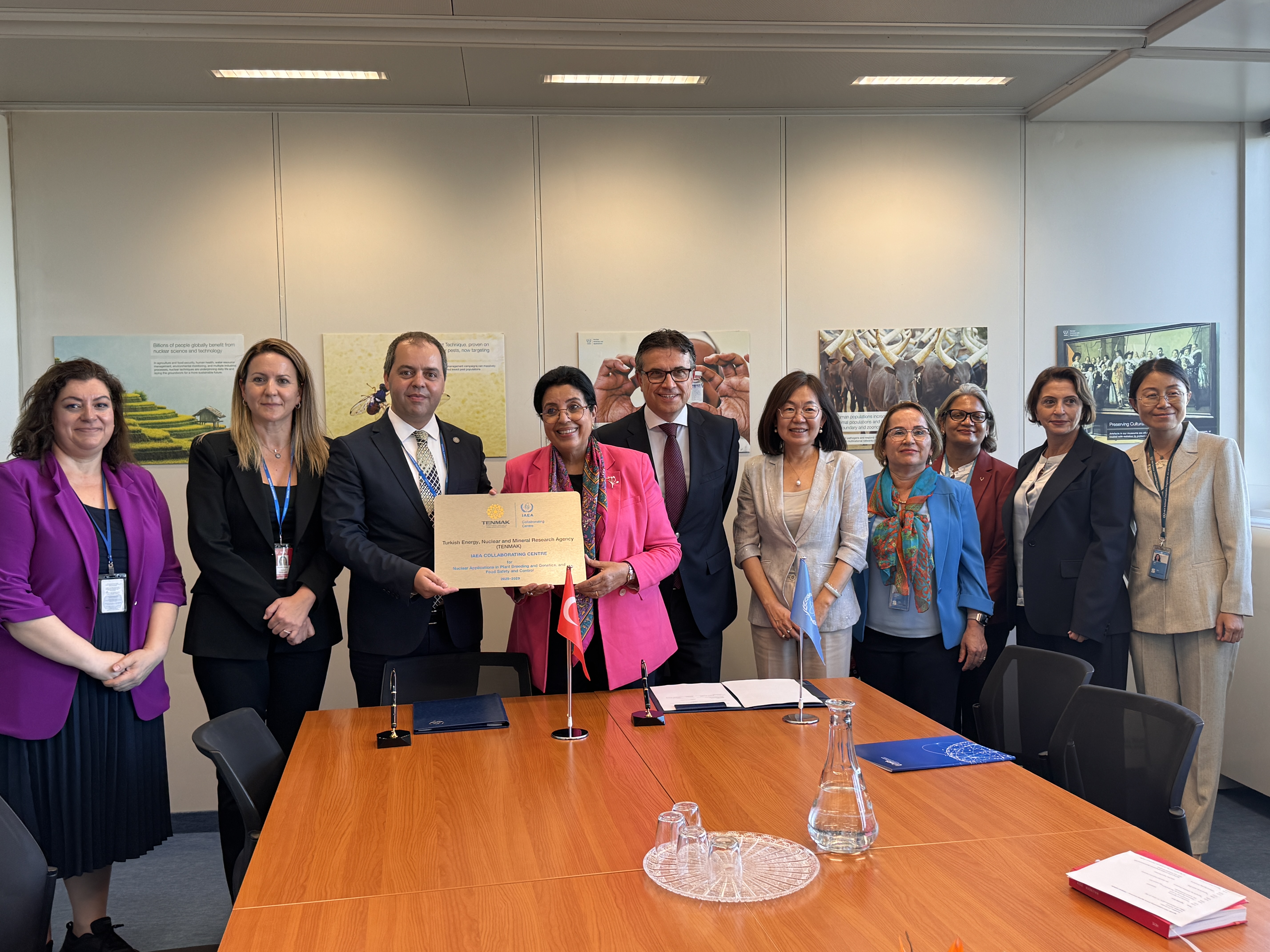
          IAEA Deputy Director General Najat Mokhtar hands over a plaque designating TENMAK as an IAEA Collaborating Centre to TENMAK President Abdullah Bugrahan Karaveli and Levent Eler, Türkiye’s Permanent Representative to the IAEA. (Photo: S. Ramirez/IAEA)

          The Nuclear Energy Research Institute of the Turkish Energy, Nuclear and Mineral Research Agency (TENMAK) has been designated an IAEA Collaborating Centre. This partnership will leverage the IAEA’s global expertise in nuclear science and TENMAK’s national capabilities to enhance research and development in mutation breeding and food irradiation. Aligning international standards with regional needs, they will tackle pressing challenges such as climate adaptation, post-harvest losses, food quality and safety, and facilitate safer international trade in food.


          “By joining forces with TENMAK, we are broadening the global network of nuclear applications in food and agriculture to address pressing challenges such as developing climate-resilient and higher-yielding crops, ensuring safer food products and supporting countries in meeting international quality and trade standards,” said Najat Mokhtar, IAEA Deputy Director General and Head of the Department of Nuclear Sciences and Applications. “This collaboration will strengthen regional capacities in Eastern Europe and Central Asia, enabling countries to apply nuclear science more effectively for sustainable agriculture, resilient food systems and safe international trade.”
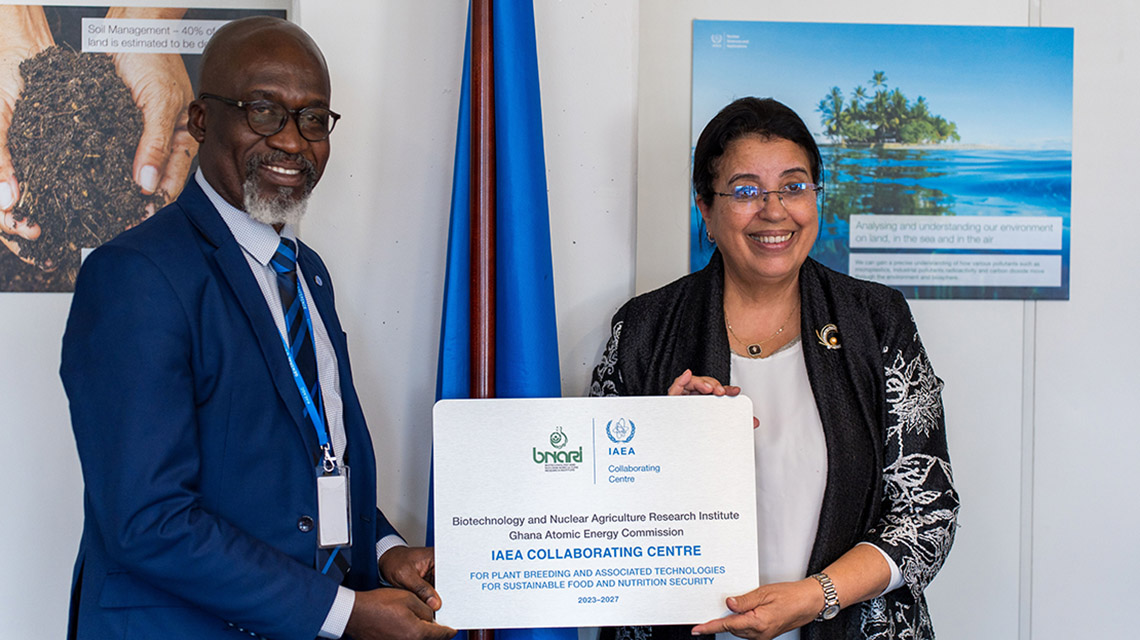
          Strengthening Collaboration for Regional Impact

          TENMAK was officially designated as an IAEA collaborating centre during the 69th IAEA General Conference. (Photo: S.Ramirez/IAEA)

          With state-of-the-art laboratories, irradiation facilities and a track record in mutation breeding and radioactivity analysis, TENMAK is uniquely positioned to support countries in the region in developing climate-resilient crops, improving food safety and applying irradiation technologies to strengthen food security. This collaboration will ensure that research outcomes are jointly developed and shared, advancing both global and regional knowledge.

          The designation of TENMAK as an IAEA Collaborating Centre integrates it into a growing network of institutions committed to applying nuclear science for peace and development. “We are proud to become an IAEA Collaborating Centre,” said Abdullah Bugrahan Karaveli, President of TENMAK. “Together we will advance nuclear applications, such as mutation breeding and food irradiation, that help safeguard food supplies, improve nutrition and strengthen agricultural trade in our region and beyond.”

          Under the agreed workplan, TENMAK will contribute its expertise in in vitro multiplication — the process of rapid propagation of plant materials to produce large numbers of genetically identical offspring — while collaborating with the Joint FAO/IAEA Plant Breeding and Genetics Laboratory on mutation breeding for both seed and vegetatively propagated crops. The institute will also leverage artificial intelligence tools to accelerate the phenotyping and selection of mutant lines. In the field of food safety, TENMAK will provide irradiation services, develop and validate analytical methods for detecting radionuclide contamination in food and promote the wider use irradiation techniques to enhance product safety, reduce post-harvest losses and facilitate trade.  


          Capacity building is a central pillar of the collaboration. TENMAK will host fellows, visiting scientists and trainees from the region, while its own experts will engage in advanced training sessions at the Joint FAO/IAEA Agricultural and Biotechnology Laboratories in Seibersdorf, Austria. Through joint projects and exchange of best practices, the institute will help strengthen national and regional capacities for developing resilient crops and ensuring safe food, directly contributing to global food security.

          Joint FAO/IAEA Centre of Nuclear Techniques in Food and Agriculture

          For over six decades, the IAEA, through the Joint FAO/IAEA Centre of Nuclear Techniques in Food and Agriculture, has been at the forefront of innovation in food and agriculture through nuclear science and technology. Its Plant Breeding and Genetics section leads global efforts to develop robust crop varieties using nuclear techniques, including mutation breeding and associated biotechnologies. This work has resulted in the release of numerous improved variations that boast higher yields, enhanced nutritional profiles, and greater resistance to biotic threats involving living organisms such as fungi, bacteria, viruses and insects, and abiotic stresses such as drought, salt and extreme temperatures.


          The Joint Centre’s Food Safety and Control section applies nuclear and isotopic methods to identify contaminants, chemical residues and adulterants in food products, while providing geographical traceability. It also promotes the safe use of food irradiation technologies to mitigate microbial contamination, extend product shelf life and ensure compliance with phytosanitary requirements for trade. By developing and validating analytical methods and facilitating proficiency tests, the Joint Centre bolsters food safety systems, supports consumer protection and maintains alignment with global food safety and trade standards.

          IAEA Collaborating Centres

          The IAEA promotes the use of nuclear technologies by partnering with designated institutions worldwide. Its network of Collaborating Centres comprises organizations that support the IAEA through research, development and training in nuclear science, technology and their safe applications. Today, the network includes 86 active centres across 42 countries.

          <dd id="rw0xn"></dd>

        2. <label id="rw0xn"></label>

        3. <sup id="rw0xn"><strike id="rw0xn"></strike></sup><label id="rw0xn"></label>
            <th id="rw0xn"></th>
          1. <var id="rw0xn"></var>
              1. <table id="rw0xn"></table>

                <sub id="rw0xn"><meter id="rw0xn"></meter></sub>
                97碰成人国产免费公开视频