From virtual reality (VR) to robotics and artificial intelligence (AI), advanced technologies can make emergency response more timely and effective, increasing safety for emergency personnel and the people and communities they are working to protect. This is especially important in nuclear and radiological emergencies, when responders need to act swiftly to protect public health and safety from the rare but serious hazards such emergencies can generate.
Radiological and nuclear emergencies are especially complex as they involve ionizing radiation. They may result from lost, stolen or abandoned sources; accidents during transport or use of radioactive material; or emergencies at nuclear power plants or research reactors. Although the malicious use of a conventional explosive device to disperse radioactive material — commonly known as a ‘dirty bomb’ — has never occurred, responders must also be prepared to respond to this scenario.
“Adopting cutting-edge technologies is vital to enhancing emergency preparedness and response,” said Karine Herviou, IAEA Deputy Director General and Head of the Department of Nuclear Safety and Security. “The IAEA actively promotes innovation and capacity building through training, cooperation and strong partnerships because high-performance tools and well-trained personnel help to ensure protection of people and the environment from radiological and nuclear hazards.”
Robotics and artificial intelligence
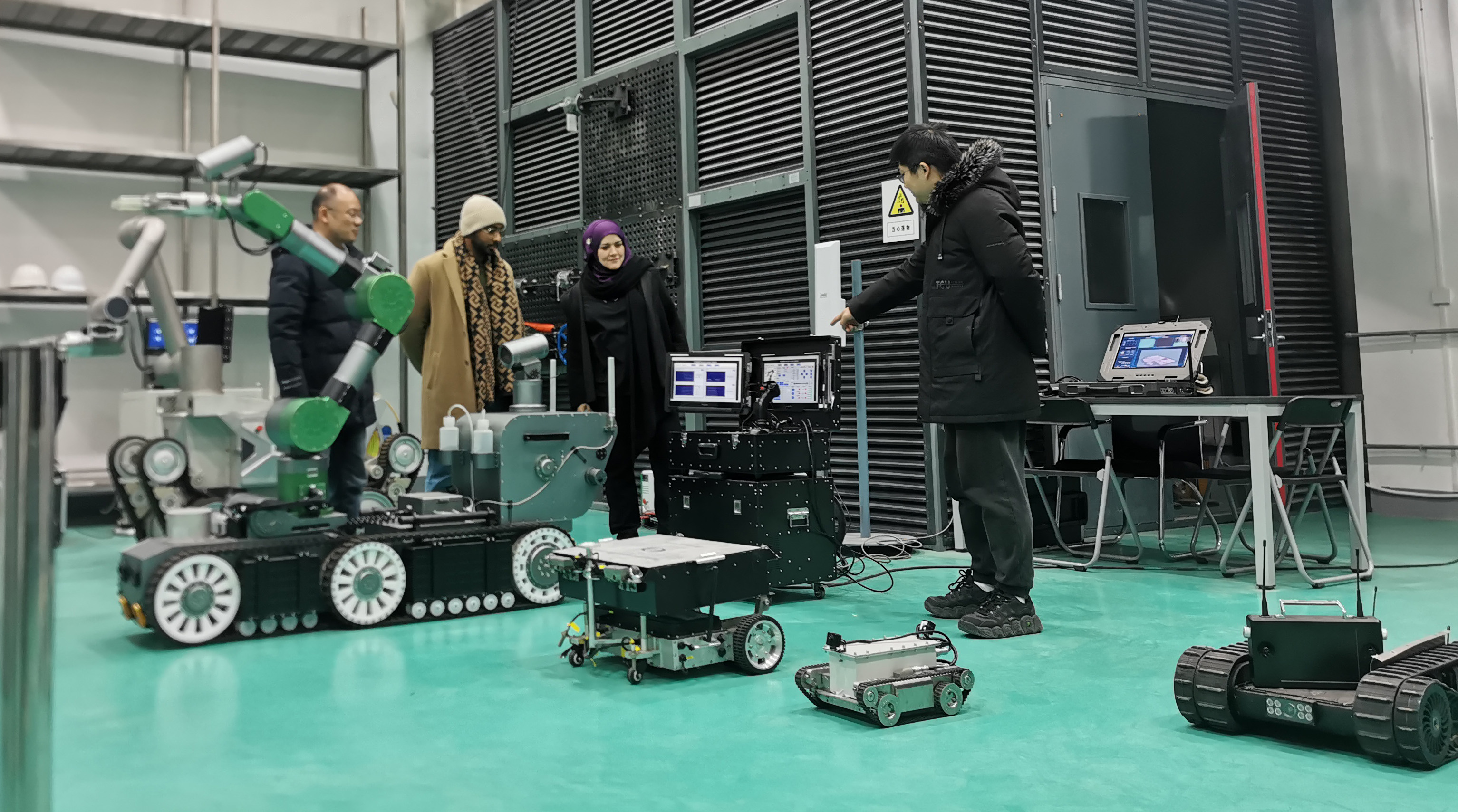
The use of robotics is rapidly gaining ground in emergency preparedness and response (EPR), including for radiological and nuclear emergencies. Robots can operate in hazardous environments, reducing the risk of physical and psychological harm to human responders while enhancing operational efficiency. Robots are already used for radiation monitoring, sample collection and surveillance in contaminated zones.
Integrating AI with robotics could enhance emergency response capabilities, enabling autonomous systems to operate in environments that are unsafe for humans. AI-enabled robots could support medical triage for individuals exposed to radiation, assist in decontamination operations, or conduct search-and-rescue missions in affected areas.
AI can also play a critical role in computer and information security in the nuclear sector. It can help detect anomalies that may indicate a cyberattack and propose real-time mitigation measures, strengthening the resilience of nuclear infrastructure.
AI can improve training for emergency response personnel. By generating realistic emergency scenarios based on probabilistic risk assessments and varying levels of severity, AI can help responders practice decision making in complex and uncertain conditions.
Virtual reality to prepare for reality
Because radiological and nuclear emergencies are low-probability, high-impact events, most emergency responders have limited real-life experience of managing them. Immersive virtual reality training provides a safe and effective way to simulate realistic emergency conditions, allowing responders to practise making critical, time-sensitive decisions.
In collaboration with the China Institute for Radiation Protection and its General Hospital of Nuclear Industry, which were designated an IAEA capacity-building centre for EPR in 2018, the IAEA has developed interactive VR training modules covering first response, extended response and medical response in a complex radiological emergency. This role-based training places users in a simulated crisis scenario — the detonation of a radiological dispersal device at a major public event — and integrates real-time decision making.
Participants learn about the steps required to protect public health and safety during a radiological emergency. For example, they practise coordinating with safety and security authorities, and engaging in effective, transparent communication with the public. To support broader implementation, the training modules can be adapted to the language and cultural context of users.
“In partnership with the IAEA, we support the development of immersive simulation tools that strengthen responders’ decision making in complex radiological scenarios,” said Liye Liu, President of the China Institute for Radiation Protection. “This contributes to global preparedness by fostering practical skills through dynamic, role-based training grounded in real-world conditions.”
These VR training modules, which were developed with support from the IAEA’s technical cooperation programme, are included in IAEA Schools for Radiation Emergency Management and will be incorporated into regional training events.
Future perspectives
“Emerging technologies hold enormous promise for strengthening nuclear and radiological EPR,” said Herviou. “Targeted research and practical evaluation are essential to fully harness the potential of these tools in training and operational support for emergency responders. The IAEA stands ready to collaborate with Member States and industry partners to advance innovative solutions that strengthen global response capabilities.”
The IAEA is seeking partners to develop a VR module on nuclear emergencies and augmented reality applications to support specific operational procedures, such as the recovery of radioactive sources or the implementation of decontamination measures during radiological emergencies.
The IAEA’s Incident and Emergency Centre maintains strong partnerships with a global network of capacity-building centres to advance innovative technologies, strengthen national response capabilities and foster knowledge management, professional networking and human resource development in EPR. Increasingly, these centres are integrating advanced technologies into their training and operational frameworks.
“Building on national capacities and with IAEA support, we aim to enhance the work of our international EPR capacity-building centre by adopting emerging technologies,” said Nasser Alkhomashi, Vice President for Emergency and Radiological Monitoring at Saudi Arabia’s Nuclear and Radiological Regulatory Commission. “This effort reinforces our commitment to preparedness for radiological and nuclear emergencies through innovation, strategic planning and operational resilience.”