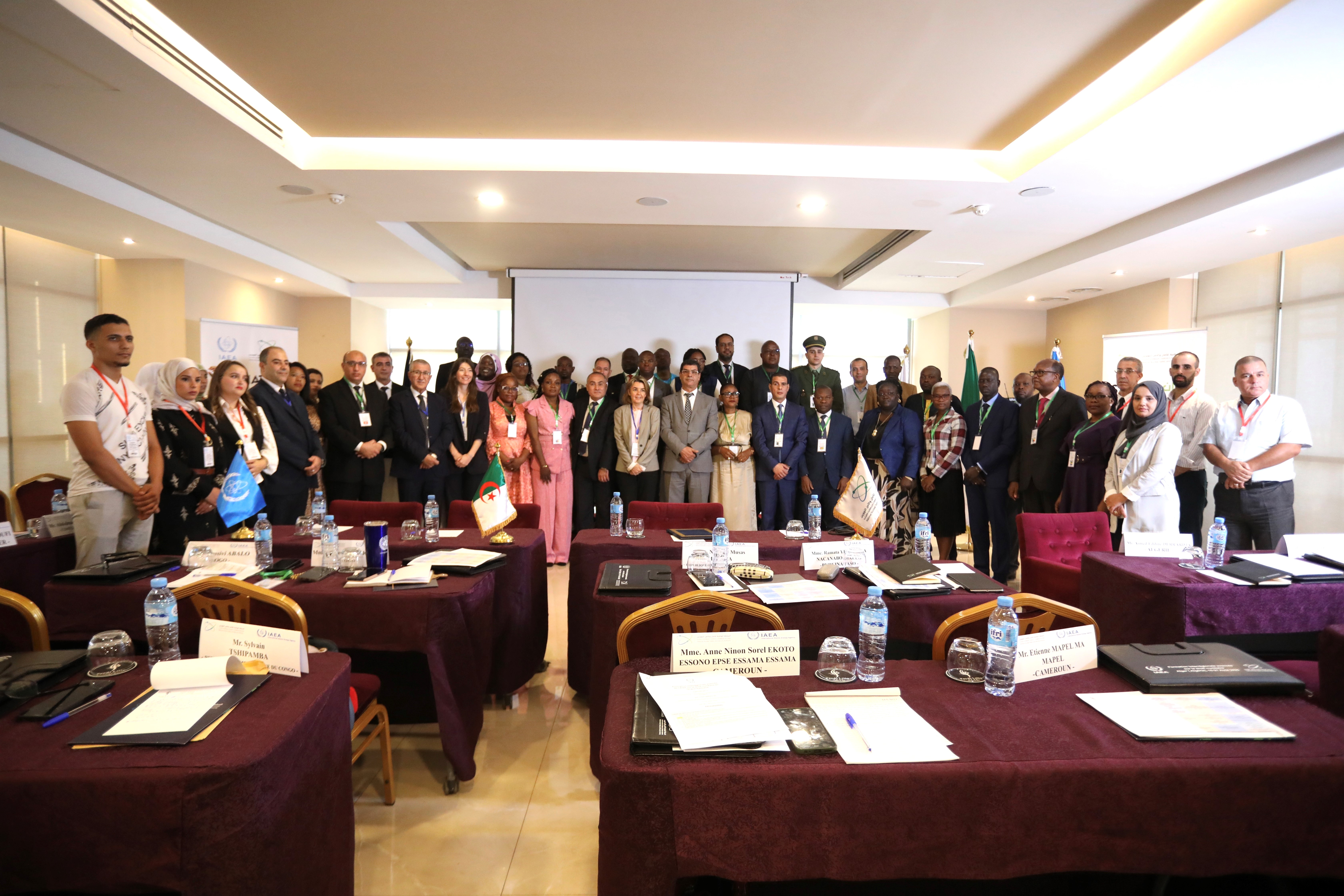
An IAEA national workshop on the legal framework for safe and secure and peaceful nuclear energy provided Burkina Faso with key information and insights on developing legislation to support the establishment of a nuclear power programme.
Organized in October 2025 in Ouagadougou under the framework of the IAEA Legislative Assistance Programme, and the Technical Cooperation Interregional Project for Legislative Assistance in cooperation with Burkina Faso’s Ministry of Foreign Affairs and Regional Cooperation , this event convened in the context of the country’s considerations to develop a nuclear power programme discussed international legal instruments on nuclear safety, security, safeguards and civil liability for nuclear damage, as well as the content of national nuclear legislation.
The aim of the workshop was to “engage national actors in understanding the entire legal infrastructure surrounding nuclear power,” said Maimounata Ouattara, Ambassador and Permanent Representative of Burkina Faso to the Federal Republic of Austria and the International Organizations based in Vienna. “Nuclear law is a very specific area of law that requires capacity building and empowerment of national actors so that they can take ownership of and domesticate the entire legal arsenal surrounding nuclear power around the world and in Burkina Faso,” she added.
The workshop strengthened stakeholders’ understanding of the nuclear legal framework both from an international and national perspective, emphasizing the need to establish an adequate nuclear legal framework to support Burkina Faso’s existing and planned activities. It also provided a platform for exchanging views on the legal requirements for the safe and secure development of nuclear energy in the country.
Sougournonma Adama Sawadogo, a lawyer in the Treaties and International Agreements Office of the Ministry of Foreign Affairs, said that the workshop discussions were enriching in terms of both theoretical knowledge and practical aspects. “They allowed me to broaden my perspective on the crucial role of nuclear law in promoting the safe, secure, and peaceful use of atomic energy,” he said. “I particularly appreciated the availability and teaching skills of the experts, who were able to make complex concepts accessible, particularly the terminology used in nuclear law.”
The event brought together representatives from key national institutions, including high-level officials and legal experts from the Ministry of Foreign Affairs, the Atomic Energy Agency of Burkina Faso, the Presidency of the Interim Legislative Assembly, the Prime Minister’s office, the Ministry for Environment, the National Agency for Radiation Protection and Nuclear Safety, the National Security Council, the Ministry for Higher Education, Research and Innovation, the Ministry of Health, the Ministry of Territorial Administration and the Ministry of Energy and Mines.
The IAEA team also held bilateral meetings with Burkina Faso’s Minister of Environment, Water and Sanitation and the Chief of Staff of the Minister of Foreign Affairs and Regional Cooperation.